
Volkswagen Golf Mk7 Owners Manual: Driving in a fuel-efficient manner
Fig. 145 compares Volkswagen Golf Mk7 fuel consumption in litres per 100 km at two different outside temperatures. Adopting an economical driving style and anticipating traffic ahead can cut consumption by 10–15% — this page explains how temperature, driving style and anticipation combine to produce that saving.
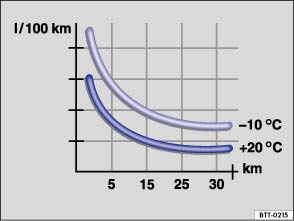
Fig. 145 Fuel consumption in litres per 100 km at two different outside temperatures
 First read and observe the introductory information
and safety warnings
First read and observe the introductory information
and safety warnings By adopting an economical driving style and anticipating the traffic situation ahead, you can easily reduce fuel consumption by 10-15%.
Cars use most fuel when accelerating. If you think ahead when driving, you will need to brake less and thus accelerate less. Wherever possible, let the car roll slowly to a stop, for instance when you can see that the next traffic lights are red.
Avoid short journeys
Directly after a cold start, the engine has a very high fuel consumption. The engine reaches its working temperature after a few kilometres, when fuel consumption will return to a normal level.
The engine and catalytic converter need to reach their proper working temperature in order to minimise fuel consumption and emissions. The outside temperature is a key factor.
The different rates of fuel consumption for the same distance at both +20°C (+68°F) and at -10°C (+14°F) are shown in .
Therefore, avoid making too many short journeys and car share whenever possible.
Under the same conditions, the vehicle will use more fuel in winter than in summer.
Not only is it illegal in some countries to warm up the cold engine by running it while the vehicle is stationary, it is also technically unnecessary and a waste of fuel.
Adjust the tyre pressure
The correct tyre pressure reduces rolling resistance and therefore also fuel consumption.
Ensure that any new tyres purchased have optimum rolling resistance.
Use low viscosity engine oils
Fully synthetic low viscosity engine oils reduce fuel consumption. Low viscosity engine oils decrease frictional resistance in the engine and spread better and more quickly, especially for cold starts. They are especially effective in vehicles that make a lot of short journeys.
Always ensure that the engine oil level is correct and that you keep to the service intervals (oil change intervals).
When buying engine oil, always ensure that it complies with engine oil norms and has been approved by Volkswagen.
Avoid unnecessary loads
A lighter vehicle is more economical and has a lower environmental impact. An extra weight of 100 kg can increase fuel consumption by up to 0.3 l/100 km.
Remove all unnecessary objects and loads from the vehicle.
Remove any unnecessary special equipment and accessories
The more aerodynamic a vehicle, the lower its fuel consumption. Special equipment and accessories, such as roof carriers or bicycle carriers, make the vehicle less aerodynamic.
You should therefore remove any special equipment and luggage carriers that are not in use, especially if you are going to be driving at high speeds.
Questions & answers
Driving in a fuel-efficient manner — Volkswagen Golf Mk7

