This page repeats the accident-evaluation context for shock absorber leaks: visible leakage often doesn't justify replacement, based on test-rig and vehicle inspection findings.
| Shock absorbers are often replaced because of externally
visible leakage. Inspections on the test rig and in the vehicle
have shown that in the majority of cases this replacement is not
justified. |
| Slight loss of fluid (“sweating”) at the piston rod seal is
not a reason for replacing a shock absorber. An oil sweating
shock absorber is acceptable under the following conditions: |
|
|
|
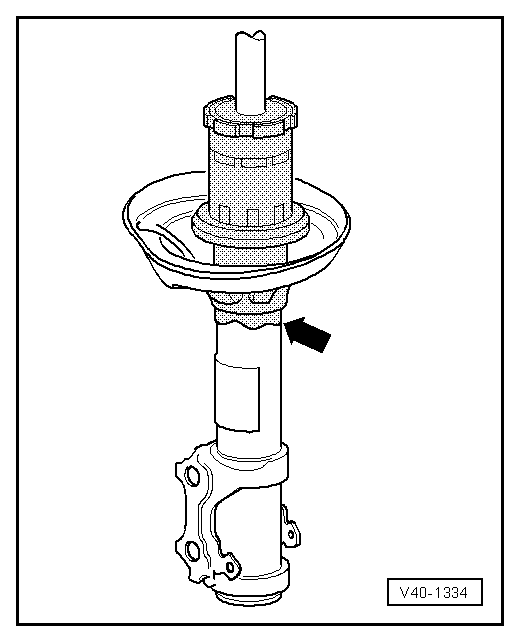
| Fluid seepage (as shown in the shaded part of the
illustration) is visible, but the fluid is dull and possibly
dried by dust. |
| The fluid seepage extends only from the top shock absorber
seal (piston rod oil seal) down to the bottom spring plate
-arrow-. |
|
|
 |
Questions & answers
Leaks at shock absorbers — Volkswagen Golf Mk7
How do I assess Golf Mk7 rear shock absorber leaks?
Same criteria as front: light film is normal, heavy drips mean replacement. DCC dampers require additional electronic fault checking.
Shock absorbers are often replaced because of noises
(rumbling, etc.) experienced by the customer. Inspections on the
test rig and in the vehicle have shown that in a ...


